Sunday, September 26, 2010

Van Gogh's France


Vincent Van Gogh's paintings burst into bright colors when he moved to southern France. He lived in Arles, and we took a walking tour of the city in which our guide, Jacqueline, pointed out some of the places he painted. This included one of his "starry night" paintings over the Rhone River, as well as a cafe in the main square that glowed yellow in the evening light. (It has since been painted yellow, so people will recognize it!)


He tried to get his painter friends to move here from Paris, but only one of them came, Paul Gaughin. He and Paul got in a big fight, and when it was over, Paul left town and Vincent cut off part of his own ear and gave the piece to a prostitute. After that, Vincent Van Gogh was put in a hospital that had a lovely garden - see photo!
But then he had to go into a mental institution, in the nearby town of St. Remy.

We visited St. Remy on a market day. It is charming.


It's sad that Van Gogh never sold any of his paintings during his life time. Such a genius, and he was able to continue painting only because his brother Theo supported him.

Award-winning photo: Please vote!

Paul took these photos of the Roman arena at Arles, on the night we arrived. I couldn't decide which was better. Please vote: which is the award-winning photo for this blog?
Photo #1

Photo #2

The Romans in France

It's hard for many Americans to fathom, but more than 2,000 years ago the Romans built an advanced civilization here in France and throughout the Mediterranean. They constructed roads, theaters, aqueducts, public baths, and fancy homes with tiled floors. After Rome fell, Europe went into the Dark Ages, where they produced almost nothing lasting in architecture, art, or literature. After 20 centuries, a surprising number of the Roman structures remain standing.

In Southern France, relatively close to Rome, the most impressive remaining structure is a bridge called Pont du Gard - built not for roads but to carry fresh spring water 30 miles from the mountains to the city of Nimes. Nimes is on a river, so it had a source of water nearby; but the Romans wanted fresh, clean mountain water - so badly that they spent huge sums of money to build a 30-mile canal over hilly terrain. This canal had to travel over a river canyon, so they built this huge bridge to take the fresh water across it. This system worked for 150 years, and the water could reach the city from the spring in just 24 hours, dropping only 40 feet during the journey. It is an engineering marvel.

We enjoyed walking under the bridge and marveling at its many arches - three layers of them, including a huge one that crosses the river itself. The bridge was built entirely with stones, with no mortar. It must have taken thousands of workers to complete it.


The city of Arles also has some awesome Roman ruins. Our hotel was a stone's throw from the two biggest. The Roman arena, or coliseum, was built for entertaining the masses: as many as 20,000 Romans would go there to watch gladiators fight to the death against lions. The exits were called "vomitorium" because they would "vomit" the people out onto the strees. Today, it is still in use - for bullfights. During the Middle Ages, townspeople lived inside it, for protection against marauders. In the late 1800s, it was reconstructed so it could be used again as an amphitheater.

Arles also has the remains of a Classical Theater, for plays and lectures. The seats are still there, but the stage has fallen apart. You can also see remnants of the old Roman forum, the central square. The Romans had a large "circus" for chariot races; on that site the French have built a museum that holds a lot of marble statues left over from Roman days, including one of Julius Caesar, who built a big city at Arles to thank it for making ships that helped him in battle.


It's cool to imagine what this city was like in the Roman days. They had quite a life.

Wednesday, September 22, 2010

Ruins or Reconstruction?

Here's a good question: Which do you think is better: to leave an old castle in ruins, or to reconstruct it to look like it did during the time it was used?


Of course, it's more fun to visit a castle that has been reconstructed. It's easier to imagine how people lived here in the old days. But it's not very authentic. How is it different from visiting copies of castles in Disneyland or Las Vegas?


We visited both, here in France. First, we went to Carcassonne. This was a medieval city, with a sturdy, high wall around it, almost impossible to invade. You can see the ramparts - in fact, a double set of thick walls. You can see the slits in the rocks, where the archers shot arrows at attackers. You can see the moat, and the drawbridge, and the portcullis, and the wooden walkways, high above, where the defenders could stand to shoot arrows or drop stones on invaders who tried to scale the walls with ladders.

It is easy to envision Carcassonne's history, when you hear how the Romans first built this fortress, how the Saracens defended this city against Charlemagne in the 800s, and how the Crusaders attacked this city in the 1100s because it was protecting Cathars, who were Christians who had different ways of worshiping than the way approved by Rome.


Carcassonne is probably the best-preserved medieval fortress city in Europe. Many parts of the walls and towers are original. But much of it was reconstructed in the 1800s. Not yesterday, but certainly not during the Middle Ages. And the place is crawling with tourists. Little shops sell lots of plastic swords for kids to play with. So, while Carassonne is awesome, it's also a bit unreal.

By contrast, Les Baux was also once a strong hilltop fortress and castle during the Middle Ages. (It's pronounced 'Lay Bo' but it is also the origin of the word bauxite, a mineral found near here and used to make aluminum.) But when we visited Les Baux, we saw only ruins. We saw authentic stone walls of the castle and the fortress, but it's much harder to imagine what it looked like in its prime. You have to use your imagination. Also, they give you an audio guide, so you can listen to a voice tell you what used to be in each spot, and how people lived.


So - What do you think? Would you rather visit a place like Les Baux, left as it was found? Or Carcassonne, rebuilt to look as it once looked? Please comment!
P.S. This is how prisoners were punished in the Middle Ages; they were put in the stocks and left to stand there for hours. Paul says it is very uncomfortable!

Tuesday, September 21, 2010

Serendipity: Two Unexpected Luncheons


When we signed up for this tour, we were given an itinerary with the plans for each day. But we were happily surprised by two lunches that we did not expect.


On the day we left Sarlat, we stopped at the Canal du Midi, which is the canal that connects the Mediterrean Sea with the Atlantic Ocean, across southwest France. (I didn't even know it existed!) We took a short trip on a barge, up the canal and through a lock to a higher level. The locks are needed because the canal has to cross higher and then lower terrain. We ate our picnic lunches on the barge.


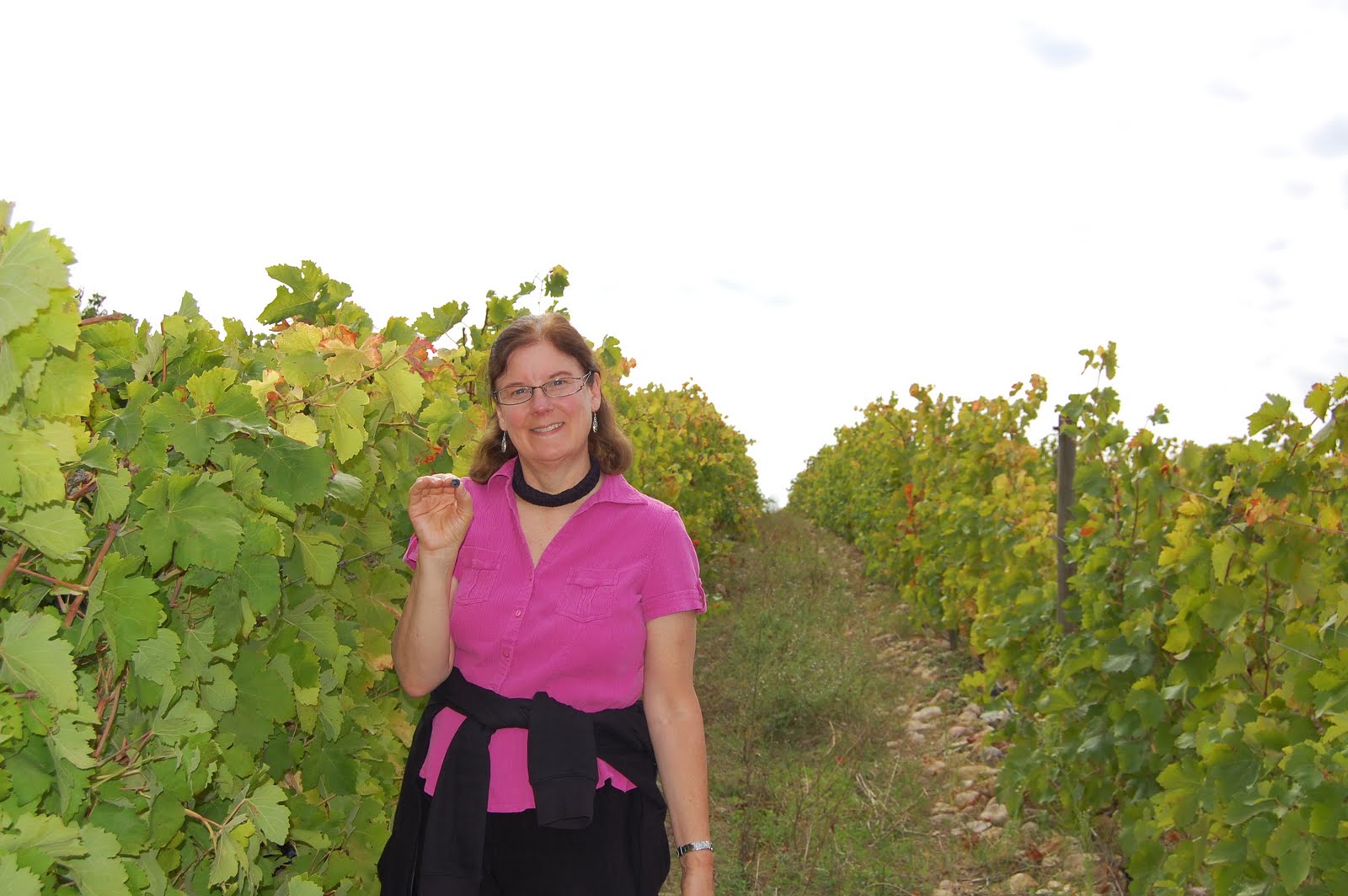
The following day, we stopped at a vineyard, where a woman named Sylviane explained to us the sustainable agricultural methods she and her husband use for growing wine grapes. They use pheromones instead of insecticide - to cause "sexual confusion" in the butterflies so they don't mate and produce caterpillars that destroy the grapes. !! They pick all the grapes by hand, and they use natural cooling methods and gravity in their wine production, which we also toured.

After the tour, we had a chance to sample several of the wines they produce. Then, Sylviane treated us to a delicious country-style lunch on their terrace, with yummy foods I had never seen or heard of before: something that looked like a tomato pizza, cold zucchini soup in a glass, pumpkin squash with duck meat, pasta salad, mackeral, tuna - and, of course, their own red wines. I wish I had taken photos of the food they served, but I was too busy eating it to take photos!


Charming Sarlat


Sarlat is a lovely little town in the Dordogne (Perigord) region of southwest France, a well-preserved but lively medieval town, a good location from which to explore the region's highlights: caves, canoe trips, duck farms, nearbly charming towns.


Frankly, Paul took so many great photos of Sarlat, it was hard to choose photos, but here are some.


On Saturday, the town of Sarlat turns into a market town, selling vegetables and fruits, cheeses, foie gras, bread, local wine, and walnut cakes, as well as handbags and clothing and souvenirs. Paul and I bought bread, ham, and cheese, as well as delicious small "Charlotte" strawberries for our picnic the next day.


On the last of our three nights in Sarlat, they had a festival of 10,000 candles, lighting up the narrow streets and winding lanes of the town. Charmant! and utterly magical.

Canoeing on the Dordogne River

The day before our canoe trip on the Dordogne River in southwest France, it was cold and rained like crazy. Many of us were pretty pessimistic about the idea of spending two hours in a canoe. But the weather shifted, and we had a glorious, sunny afternoon, with blue skies, pleasantly warm air, soft breezes, and smooth water. It could not have been a better day for canoeing!
Most canoes held two people, so Paul and I had our own. We pushed off first, and could not believe the gorgeous, calm waters. Much of the river has lovely greenery on both sides, but we also passed three bridges, several castles, and some beautiful little towns, typical of the Perigord Region.


It was a terrific experience! And nobody fell in the water.